Mental Health Stigma, or, Why We Should Leave Amanda Alone

Image from NY Daily News

Image from NY Daily News

The inevitable has happened: Amanda Bynes has been put under a 72-hour psychiatric hold in LA. Her parents are seeking conservatorship of her affairs after over a year of bizarre behavior, most recently in the form of some severe Twitter allegations* about her father abusing her as a child, and a tweet recanting her statement and blaming it on a microchip her father had implanted in her brain. This is a familiar story. One can easily remember Britney Spears going through similar issues, attacking paparazzi with an umbrella and famously shaving her head. Or Lindsay Lohan, landing in court case after court case, and suffering from substance abuse. But it’s all too easy to forget that these celebrities are people, and they are going through (or have gone through) some mental health issues. And so have a lot of people.

Mental health diagnoses can be things like phobias, anxiety disorders, eating disorders, depression, substance abuse and schizophrenia. According to the National Institute of Mental Health (NIMH), in 2012 approximately 4.1% of US adults were suffering, or had suffered, with a serious mental illness within the last year. That might sound small, but that only accounts for a serious mental health diagnosis. The same year approximately 18.6% of US adults had suffered from mental illness in general. That’s almost 1 in 5! So, in reality, what Bynes is going through is a common experience, and she doesn’t deserve increased scrutiny about her mental health state just because she’s been in the public eye since she was seven.* * Let’s make like Britney and leave Amanda alone.

There’s a well-known relationship between stress and mental disorders. Obviously, the attention a celebrity receives is bound to be stressful, but sources of stress can range from your job to childhood abuse. Some illnesses even appear to be more common in populations of people who experienced some type of extreme or chronic stress (1,2). Working full time and juggling school from a young age could definitely act as a source of stress, which may help to explain the incidence of mental disorder in people who were child stars (and, similarly, in impoverished populations; 3). Clinicians believe that something called the gene by environment interaction (G x E) plays a large role in mental illness (4,5). Basically, it means that even if you have some sort of hereditary vulnerability to a mental illness, it may take environmental stressors to actually end up developing the disorder. Illnesses like Post-Traumatic Stress Disorder (PTSD) may be especially impacted by environmental factors. Soldiers deployed to Iraq during Operation Iraqi Freedom had a PTSD prevalence rate of 19.3% (6). Mental illness may ultimately be something that is brought out in us by our circumstances, rather than something that we “have.”

Regardless of how people come to be diagnosed with a mental disorder we know that mental illnesses are just as debilitating as physical ones. People living with mental illness may suffer from symptoms ranging from anhedonia and rumination, to things like delusions and suicidal thoughts. In fact, according to the National Alliance on Mental Illness, 90% of the people who commit suicide have received a mental health diagnosis. One of the reasons may be the amount of stigma that surrounds mental illness. Stigma can reduce self-esteem and opportunities to be social, and increase stereotyping and prejudice (7). There is also evidence that populations that endure prejudice are more likely to develop a mental illness, illustrating the complexity of the G x E interaction (8, 9, 10).

So let’s give Bynes’ bizarre behavior a pass. If she’d been diagnosed with cancer, people would empathize with her and leave her alone instead of hounding her and putting her in the spotlight. Mental illness is just as serious as any illness a person can have, and it’s past time we learned to see people beyond their maladies, regardless.

*Anyone who knows me well will know how much it pained me to write the phrase “severe Twitter allegations.”

**Ok, ok, she was 8 in this one. Sue me. I didn’t have the energy to deep Google it. I also totally had those Barbie™ hair extensions.

If you or someone you know is considering suicide, there is help. Visit the National Suicide Prevention Lifeline the American Foundation for Suicide Prevention, helpguide.org , or call the National Suicide Prevention Hotline (1-800-273-8255).


  1. Belle, D. (1990). Poverty and women’s mental health. American Psychologist, 45(3), 385-389.
  1. Horwitz, A. V., Widom, C. S., McLaughlin, J., & White, H. R. (2001). The impact of childhood abuse and neglect on adult mental health: A prospective study. Journal of Health and Social Behavior, 42(2), 184-201.
  1. Liem, R., & Liem, J. (1978). Social class and mental illness reconsidered: The role of economic stress and social support. Journal of Health and Social Behavior, 19(2), 139-156.
  1. Lesch, K. P. (2004). Gene-environment interaction and the genetics of depression. Journal of Psychiatry and Neuroscience, 29(3), 174-184.
  1. van Os, J., Rutten, B. P. F., & Poulton, R. (2008). Gene-environment interactions in Schizophrenia: Review of epidemiological findings and future directions. Schizophrenia Bulletin, 34(6), 1066-1082.
  1. Hoge, C. W., Castro, C. A., Messer, S. C., McGurk, D., Cotting, D. I., & Koffman, R. L. (2004). Combat duty in Iraq and Afghanistan, mental health problems, and barriers to care. New England Journal of Medicine, 351, 13-22.
  1. Corrigan, P. (2004). How stigma interferes with mental health care. American Psychologist, 59(7), 614-625.
  1. Mays, V. M., & Cochran, S. D. (2001). Mental health correlates of perceived discrimination among lesbian, gay, and bisexual adults in the United States. American Journal of Public Health, 91(11), 1869-1876.
  2. Meyer, I. H. (1995). Minority stress and mental health in gay men. Journal of Health and Social Behavior, 36(1), 38-56.
  3.  Meyer, I. H. (2003). Prejudice, social stress, and mental health in lesbian, gay, and bisexual populations: Conceptual issues and research evidence. Psychological Bulletin, 129(5), 674-697.


Bias Blind Spot

Screen Shot 2014-10-05 at 6.05.11 PM

Image from Digital Journal

Ah, it’s that time of year again. Pumpkin spice everything, apple cider, political elections… And of course, with elections come those discussions we all know and love about how _______ party is full of it and _______ party has all the answers. Having a conversation with someone with different beliefs than you is often an exercise in futility, with one of you insisting that the other one doesn’t know jack. One of the reasons that we may engage with others this way is bias blind-spot. Bias blind spot is the tendency to easily recognize bias in others, but an inability to recognize it in ourselves. In a group of studies, participants rated themselves as less susceptible to biases than other people, were more likely to consider their assessments of themselves as objective even after being told they could be biased, and were more likely to say that other people’s attributions about performance on a test were biased, but that their own attributions were not (1). So next time you pull onto condescension highway, check your bias blind spot first.

1. Pronin, E., Lin, D.Y., & Ross, L. (2002). The bias blind spot: Perceptions of bias in self versus others. Personality and Social Psychology Bulletin, 28(3), 369-381.

The Real Threat of Ebola

The largest Ebola outbreak in history is happening right now in Africa, with the first confirmed case diagnosed in the US just this past week. Admittedly, reports of Thomas Eric Duncan’s health are not good, with his status being upgraded to critical yesterday. But we also know that he is not getting the experimental drug that the patients brought back from Africa all received (Kent Brantly, Nancy Writebol, Richard Sacra, and an unidentified doctor).** And we know that his family and those closest to him are being monitored by the Center for Disease Control, as well as over 100 people suspected of coming into contact with Duncan.

Screen Shot 2014-10-03 at 6.48.27 PM

Image from Vox.com

This infographic making its own viral path through the interwebs pretty much sums up what we know about getting this disease: Ebola is not an airborne virus, and must be contracted by coming into contact with an infected person’s bodily fluids. This article provides a great overview of how an Ebola infection can occur (spoiler alert: the big 3 risk factors are caring for a patient at home, treating a sick person without using protective wear or preparing victims for funerals). Overall, the death toll of the current outbreak hovers around 50%. So what does this tell us about the spread of and vulnerability to this virus? Essentially that it is HIGHLY unlikely that you will contract Ebola here in the US, and you probably should not be traveling to West Africa any time soon. In addition, my mom would tell you to wash your hands and carry hand-sanitizer (she’s right). But psychologically, it’s a bit more complex.

Over 100 Americans died of the flu during the 2013-2014 flu season, over 580,000 people died of cancer in 2013 and over 52,000 people died of pneumonia in 2011. So far, there has been 1 diagnosis of Ebola in the US, and 0 deaths, yet many people are absolutely terrified that they will catch Ebola at an airport or other public space. Overestimating the likelihood of the occurrence of an event based on the amount of available examples is something called the availability heuristic (1,2). One reason that we are more concerned about dying from Ebola than dying from the flu is because we can think of a lot of available examples of people who have died from Ebola, and we can think of no or very few examples of people dying from the Flu. Yet, we know it is far more common in the US.

Now that we know how unlikely it is that we will get Ebola (phew!), and we know why people are reacting so viscerally to the management of Ebola in the US, let’s turn to a potentially huge problem of this outbreak: Disease threat and it’s associated behaviors. Disease threat is managed interpersonally by something evolutionary psych researchers call the Behavioral Immune System (BIS). The BIS works by subconsciously preventing you from exposing yourself to disease threats, stopping illness before it happens (3). One of the ways this happens is through the disgust response (4). Bodily fluids tend to be fairly gross, causing a visceral reaction and encouraging people to get as far away from them as possible. This response is generally a good thing in terms of limiting sources of contagion, but it can also work through ethnocentrism (5). There is evidence that when people are feeling threatened by disease, they are more likely to show preference for their own groups, they are more likely to exhibit conformity and they exclude outgroups (6).   Unfortunately, this effect also tends to isolate people with physical disabilities or disfigurements, who are somehow seen as possible contagion sources even though the vast majority of disabilities are not the result of contagious disease (7, 8).

The risk of being exposed to increased prejudice and brusqueness from our fellow Americans is a far greater threat to all of us than the Ebola virus. In addition to it being incredibly unlikely that there will be an outbreak in the US, the probability that a person you are interacting with has come into contact with Ebola is practically nonexistent. So be vigilant with your hand-sanitizer, not with the strangers you meet.

* Thanks to Dr. Mark Leary for the idea for this article!  Check out his work about self-presentation and self-compassion here.

**October 6th news reports that Duncan has received an experimental drug, though not the same as Brantly and Writebol.  Sacra apparently got a different drug as well.

  1. Tversky, A., & Kahneman, D. (1973). Availability: A heuristic for judging frequency and probability. Cognitive Psychology, 5, 207-232.
  1. Tversky, A., & Kahneman, D. (1974). Judgment under uncertainty: Heuristics and biases. Science, 185, 1124-1131.
  1. Schaller, M., & Park, J.H. (2011). The behavioral immune system (and why it matters). Current Directions in Psychological Science, 20(2), 99-103.
  1. Oaten, M., Stevenson, R.J., & Case, T.I. (2009). Disgust as a disease-avoidance mechanism. Psychological Bulletin, 135(2), 303-321.
  1. Navarrete, C.D., & Fessler, D.M.T. (2006). Disease avoidance and ethnocentrism: The effects of disease vulnerability and disgust sensitivity on intergroup attitudes. Evolution and Human Behavior, 27, 270-282.
  1. Murray, D.R., & Schaller, M. (2012). Threat(s) and conformity deconstructed: Perceived threat of infectious disease and its implications for conformist attitudes and behavior. European Journal of social Psychology, 42, 180-188.
  1. Ackerman, J.M., Becker, D.V., Mortensen, C.R., Sasaki, T., Neuberg, S.L., & Kenrick, D.T. (2009). A pox on the mind: Disjunction of attention and memory in the processing of physical disfigurement. Journal of Experimental Social Psychology, 45(3), 478-485.
  1. Park, J.H., Faulkner, J., & Schaller, M. (2003). Evolved disease-avoidance processes and contemporary anti-social behavior: Prejudicial attitudes and avoidance of people with physical disabilities. Journal of Nonverbal Behavior, 27, 65–87.

Check your privilege

Let’s talk about privilege. White privilege. Male privilege. Class privilege. Straight privilege. All of those categories of people’s identities that dictate how they experience the world, whether they like it or not, and of which there are many more. We often think about privilege from a sociological perspective: institutional racism/sexism/other -isms, and limitations and expectations imposed on people by mainstream society. But what if we thought about privilege through a psychological lens? Specifically, what if we considered the role of the individual both in perpetuating and recognizing unfair privilege in society?*

This summer I taught Social Psychology to undergraduates. To prepare for class, I would do my best to incorporate cultural and relevant examples of topics and processes to make them more relevant and relatable to my students, which got me thinking about the fundamental attribution error and its role in perpetuating privilege in all of its various forms.

The fundamental attribution error (FAE) is a topic covered early in social psychology courses. It’s covered early because it reveals a basic (fundamental, if I may) flaw in the way that people interpret the world. Briefly, the FAE refers to the tendency of people to assume that another person’s behavior is caused by something inherent about that person—their disposition, their personality, etc.—rather than taking the situational context in mind. Consider this scenario: you see someone you know walking toward you on the sidewalk. You smile and wave, but this person walks right past you without any acknowledgment. “How rude!” you think. I thought he was a nice person, but maybe I was wrong, you might conclude. If your thinking follows that pattern, then you just committed the FAE. In all likelihood, the person you knew probably just didn’t see you. His behavior was a function of the situation—maybe he was in a hurry—and not an indicator of who he is as a person. This type of example is often how the FAE is taught, particularly because social psychology studies the individual as its unit of analysis.

But the FAE has significant implications for privilege if you zoom out and examine its influence on a societal level. It relates to privilege because the groups of people who are likely to be oppressed and systematically discriminated against as a function of white (or male or any other type) of privilege are also likely to be victims of the FAE. One of the components of privilege is that you are not seen as an ambassador or a “token” of your group (see any of the links above). One man doesn’t speak for all men. One white person doesn’t speak for all white people. These examples seem obvious. Yet, people who fall outside of these privileged groups often carry the burden of being viewed as the sole representative of their group. If one black person speaks, that person is more likely to be seen as representative of all black people, which is an incredibly unfair responsibility.

Combined with the tendency of people to commit the FAE, you can see the problem. That is, if a black woman is treated unfairly at a checkout counter, and she responds in frustration or anger, the unfortunate consequence is that people are less likely to perceive and consider all the different factors in the situation. Rather than see this woman as someone who is reacting appropriately (or at the very least, justifiably) to her current experience, people are likely to make two assumptions: 1) decide that this woman is an angry and impatient person, and 2) extend that judgment to all black women, which helps to explain the trope of the “angry black woman.” The FAE contributes to the first assumption, and white privilege is responsible for the second. Because not only does white privilege inordinately and unfairly favor white people, it does so at the expense of people of color. Not only do white people get boosted up and given the benefit of the doubt, but people of color get pushed down further. Replace white with male, straight, or class, and people of color with female/trans, gay, or poor, and you get a staggering number of different biased scenarios**.

It’s not all bad news, however. Combating the FAE is possible, although it may require some effort. Those who don’t commit the FAE may simply be more empathic people, but they also tend to be people who know that the FAE exists. They understand how it works and are aware of the shortcomings of human perception. People who know about the FAE can work to pay more attention to situational factors that may explain someone’s behavior without jumping to the conclusion that an act is because of a person’s disposition. For an excellent example of how to do this, check out this video:


As for privilege, recognizing its existence is one of the first steps to not being complicit in it. I’m talking to those of you who fit in to some privileged group or another. Many of us do find ourselves in at least one group of privilege at some point in our lives—remember I’m speaking to you from my perspective of a white middle class person. No, we didn’t ask for this privilege. No, we don’t think it’s fair. No, it doesn’t matter that we think these things. Like the FAE, privilege is subtle and must be acknowledged as an initial step. Recognition is just the first step. We must pay attention to it and understand how it affects situational factors in our daily lives, and then take steps to correct that. It’s a lot to take on, but the weight is very little compared to what non-privileged folks must bear every day. Doing so is the only acceptable alternative if we want individuals to contribute collectively to true racial and social justice. If you’re not sure how or you’d like to learn more about privilege, start by reading any of these blogs below.

Resources:

Black Girl Dangerous

TimWise.org

Decolonizing Yoga

It’s Pronounced Metrosexual


*I recognize that the fact that I can choose when I want to think about privilege is, in fact, another element of my white privilege. Not everyone has that luxury.

** I chose to focus on white privilege for two reasons: 1) As a white person, I’ve benefitted from and experienced white privilege all my life, and 2) the heart-wrenching and infuriating race-related events of the last few months, particularly in Ferguson, Missouri.

Unpacking Ello

Ello's minimalist design

Ello’s minimalist design (Screenshot of Mallory’s first sign-in to Ello)

Yesterday, I saw a status on Facebook about a new invite-only “anti-facebook” social network: Ello. FOMO ensued. What was this minimalist social network? Why had I never heard of it? What was I missing?! I had to know, so I asked the friend for an invite to see what the fuss was about. I signed up and…it’s definitely minimal. Having launched beta-testing this past July, Ello is meant to be ad-free. Which equals no ads, or the fancy interfaces they pay for. But also, no signing onto this social network wondering how they know you’ve been waiting for those sweet high-top Missoni Chuck Taylor’s to go on sale (story of my life). So why has Ello blown up recently? Yesterday, CNET reported that they have 35,000 sign-ups an hour. The social psychologist in me wonders what’s making Ello the new up-and-coming social network, and why. Here are some hypotheses:

  1. There’s an increasing desire for a social network that isn’t manipulative.

We all know what those ads pay for (i.e. cool features and sleek design), and what they cost (i.e. your data and your privacy). With the recent uproar over the Facebook mood contagion experiment, social media users are calling for the ability to network without any “secret algorithms” or tracking cookies following them all over the web. A study by Debatin et al found that users who experienced privacy violations were more likely to change their privacy settings than were users who only heard about privacy violations (1). Almost 700,000 Facebook users timelines were manipulated, which left many users wondering if they were in the sample and feeling distrustful.

  1. People love exclusivity.

The $10,000+ Hermes Birkin Bag is infamous for its waitlist, people were still waiting in line for over two weeks to be among the first to own the new iPhone 6 (now in its 5th generation), and elite New Yorkers duke it out for months over a small number of pre-school spots for their kids, costing as much as a year of college tuition. All of these examples share a common element: Scarcity, a well-known persuasion tactic. A classic study by Worchel et al found that participants valued cookies more highly when they were in a near-empty or rapidly-emptying jar, than when they were in a full or rapidly-filling jar (3). Indeed, scarcity is so powerful it is one of Cialdini’s 6 principles of persuasion.

  1. Brand authenticity is especially hot right now.

Craft breweries are raking in the big bucks, with some marketers suggesting that it’s due to their masterful upstart narratives. Unlike Bud Lite, when you crack open a 21st Amendment Fireside Chat, you know where the beer was made and you feel like you’re supporting some bearded young man with a fermentation tank and a dream. Creating this kind of subculture may be one way brands achieve authenticity. Research by Leigh et al found that MG car owners derived a sense of authenticity from belonging to the MG subculture (2). Participating in a subversive subculture like Ello may have the added allure of the perceived authenticity of the community in light of anti-establish statements, like their manifesto.

The verdict is still out on whether or not Ello will succeed, but there may be strong social forces at work in its burgeoning popularity.

  1. Debatin, B., Lovejoy, J.P., Horn, A.K., & Hughes, B.N. (2009). Facebook and online privacy: Attitudes, behaviors, and unintended consequences. Journal of Computer-Mediated Communication, 12(1), 83-108.
  1. Leigh, T.W., Peters, C., & Shelton, J. (2006). The consumer quest for authenticity: The multiplicity of meanings within the MG subculture of consumption. Journal of the Academy of Marketing Science, 34(4), 481-493.
  1. Worchel, S., Lee, J., Adewole, A. (1975). Effects of supply and demand on rating of object value. Journal of Personality and Social Psychology, 32(5), 906-914.

Mental shortcuts and portion control

Flickr user eddie welker

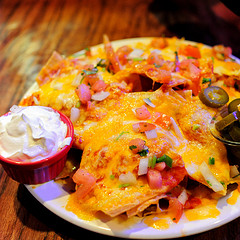
Standard cheesy nacho connectedness (Image courtesy of flickr user Eddie Welker)

Have you ever picked up a chip from a plate of nachos only to find that it was stuck to several others, creating one large nacho mass of cheesy goodness? Or maybe it happened with cookies that had been baked together. Regardless of the specific food, how many times have you looked at that larger-than-intended portion in your hand and shrugged while thinking, it’s still just one nacho (or cookie or whatever). If so, you are not alone!

People are constantly inundated with a multitude of stimuli from their environments, particularly when making decisions about eating. To simplify things a bit, people rely on heuristics (or mental shortcuts) to keep them from becoming overwhelmed by the number of decisions, such as how many cookies to eat, what type of cookies, when do I want them, and so on.

The unit bias heuristic is the tendency to sense that a single entity is the appropriate amount of food to eat, regardless of how big that entity is (1). In other words, eating a cookie, no matter how big that cookie is, feels acceptable and not guilt-inducing to most people, despite the fact that the cookie size may actually be comparable to three cookies.

Naturally, people vary in how frequently they rely on unit bias and also in the size of the typical unit used. For example, one large cookie or a full package of cookies can both be considered to be a single unit depending on the person or the circumstance. Unit bias doesn’t become particularly problematic to people’s health unless they are regularly consuming extra-large portions as one unit, such as a full bag of chips or an entire box of cereal.* In these cases, people may need external support, sometimes called segmentation cues (2), to provide indicators to stop eating. Segmentation cues are also often called “portion control.” For example, 100-calorie snack packs act as a cue to limit your intake of a particular food item.

To learn more about unit bias and segmentation cues, check out the papers below, or email us at Socialpsyq@gmail.com.


(1) Geier, A.B., Rozin, P., & Doros, G. (2006). Unit bias: A new heuristic that helps explain the effect of portion size on food intake. Psychological Science, 17, 521-525.

(2) Geier, A.B., Wansink, B., & Rozin, P. (2012). Red potato chips: Segmentation cues can substantially decrease food intake. Health Psychology. Advance online publication. doi: 10.1037/a0027221


* Of course, these portions don’t apply to everyone. If someone is a high performance athlete, for example, then their calorie intake will look very different from the average person.

Psych in Sum

Screen Shot 2014-09-14 at 7.28.41 PM

Image from IKEA catalog

Ever spent a few frustrating hours trying to put together a large piece of furniture from IKEA? Or perhaps you’ve put in some hours refinishing a piece of furniture, or pinteresting your way to a chair made out of a whiskey barrel. Well, research shows that you may become especially attached to things that you build (1). Results in this study showed that participants were likely to bid more money for things they built, and felt that their skill was comparable to experts. Basically, you DID that bookcase, and you know it.

(1) Norton, M. I., Mochon, D., & Ariely, D. (2012). The IKEA effect: When labor leads to love.” Journal of Consumer Psychology, 22 (3), 453–460.

Psych at Work

Brandon Stanton (fellow Bulldog!) harnessed the power of social media to become a popular street photographer with his facebook page Humans of New York. Stanton uses his unique skill for combining photography and storytelling to bring people together all over the world. With its humbling subjects and profound wisdom, Humans of New York attracts mostly positive comments (a feat in the digital age). One reason that people may enjoy the page so much is the fact that they are exposed to people of different races, nationalities, and backgrounds in a way that’s accesible. This seems to make interactions with outgroup members on the page more positive, and thereby increasing liking of those outgroups, and decreasing negative interactions. Otherwise known as the contact hypothesis!

Screen Shot 2014-09-14 at 7.32.17 PM

Image from Spav Corridor

Should kids avoid the cereal aisle for their health?

cerealboxpsychology01

Image courtesy of Cornell Food and Brand Lab

Is it just me, or is the cereal aisle much more complicated and sinister compared to when we were kids? Every time I walk down that aisle, my frustration spikes. The choices, so many choices! Chocolate Krave. Cap’n Crunch. Chocolate Cheerios. Frosted Flakes. Even Rocky Mountain Chocolate Factory has a cereal now, featuring chocolate bits that you can eat for breakfast. That last part is meant to pull in the kids, and it works. Those kids will nag their parents to buy it who will eventually give in[i] because, oh, they’re frustrated, too. Maybe even more than I am.

I’m not frustrated because of the mere existence of so many options necessarily. Rather, it’s the quality of the options that is concerning. Are any of these cereals actually healthy enough that children should be consuming them regularly? Not usually. A recent study on cereal quality found that cereal brands marketed to children had 56% more sugar, 52% less fiber, and 50% more sodium than cereals marketed to adults.[ii] Most of these cereals also feature spokes-characters, like the silly rabbit from Trix, Cap’n Crunch, or Tony the Tiger, which are familiar to children and increase the appeal of the cereal brand. And let’s not forget that the combined rate of obese and overweight children in this country is still holding strong at 17%.[iii] That’s nearly 13 million kids.

See what I mean about sinister? Now, brand marketing is not inherently negative, but when marketing of unhealthy foods is targeted toward children, then cereal companies like Kellogg and General Mills take a step into the danger zone. Sugary cereals are perhaps even more insidious than other snack foods because they are junk foods disguised as a friendly breakfast.

In-store marketing strategies take it one step further. Cereal companies pay top dollar to get an ideal shelf location that will appeal to children[iv]. In a recent study published in the journal Environment and Behavior, researchers found that cereal brands marketed to children were more likely to be at a child’s eye level and to contain spokes-characters whose gazes angled downward at approximately the height of an average child[v]. In contrast, cereals marketed primarily to adults featuring spokes-characters (think Wheaties) had level gazes. And this seemingly subtle shift in height and gaze is effective. People in the study reported a strong preference for the cereal that featured a spokes-character that made eye contact. By placing their cereals on the middle or bottom shelf, then, companies are ensuring that children will make eye contact with spokes-characters and feel connected and loyal to that brand.

This type of marketing exploits and manipulates children. Cereal companies should be held more accountable. In the past few years and in recent months, especially, there has been a serious push to create stricter regulations for companies that market primarily to children. Based on the findings of Musicus and colleagues, just one of many similar studies, these regulations can’t come soon enough. The issue of obesity is still current. People may be tired of hearing about it, and obesity rates may have stabilized in several states[vi], but that doesn’t mean that it’s gone away.

But even if we take obesity out of the equation, even if we recognize that not all children have the same risk factors for becoming obese, it doesn’t mean that kids should be regularly consuming unhealthy sugary food. Parents want to protect their children in every way they can, and they’re stretched to their limits as is. Cereal companies, and all other food companies for that matter, should be held to stricter regulations. Some marketing standards have been successfulvii, but more needs to be done. Regulations should stretch beyond nutrition and include specific marketing techniques, such as shelf placement and use of spokes-characters. We shouldn’t make the cereal aisle another battleground where parents need to be on the front lines.

Posted by Jen

~~~~~~

If you’re interested in this topic and would like to learn more, check out the links below.

Center for Science in the Public Interest: Food Marketing Workgroup

Yale Rudd Center for Food Policy and Obesity

Healthy Eating Research

Salud Today

Eyes in the aisles: Why is Cap’n Crunch looking down at my child? (abstract)

[i],vii A Review of Food Marketing to Children and Adolescents — Follow-Up Report. See http://www.ftc.gov/reports/review-food-marketing-children-adolescents-follow-report .

[ii] Harris, J. L., & Graff, S. K. (2012). Protecting young people from junk food advertising: Implications of psychological research for First Amendment law. American Journal of Public Health, 102, 214-222.

[iii] http://www.cdc.gov/obesity/data/childhood.html

[iv] Wilkie, W.L., Desrochers, D.M., & Gundlach, G.T. (2002). Marketing research and public policy: The case of slotting fees. Journal of Public Policy and Marketing, 21, 275-288.

[v] Musicus, A., Tal, A., & Wansink, B. (2014). Eyes in the aisles: Why is Cap’n Crunch looking down at my child? Environment and Behavior, 0013916514528793.

[vi] http://www.latimes.com/science/sciencenow/la-sci-sn-american-obesity-crisis-stabilizing-20140904-story.html.

Can iPhones predict your happiness?

1287221843_cabd428ab2_z

Old-school generation iPhone 4s (Image from flickr.com)

Well, it’s here. The iPhone 6. And suddenly, predictably, everyone with an iPhone 5s or lower feels inadequate. Sales for the iPhone 6 are predicted to be greater than iPhone sales ever before. Someone I went to college with posted on Facebook yesterday, “The iPhone 6. A piece of s!%t compared to the iPhone 7.” He posted the same thing when the iPhone 5 came out a few years back. His post is funny precisely because it captures the sentiment of the technological version of “keeping up with the Joneses.” It says that people are looking to the next cool device already.

The iPhone is not the first device or product marketed to have such a reaction on consumers. Other devices in the tech world and the fashion world, in particular, seem to rely on this notion of being up to date and “en vogue,” if you will.

So, Apple is simply capitalizing on a pattern that seems to be part of the human condition and that other companies also capitalize on to, well, make capital. But what is it that makes people so eager to give up the devices or clothes they’re currently using or wearing, most likely something they were perfectly satisfied with, and clamor to get the newest and latest?

It could be something social psychologists call affective forecasting. Affective forecasting is the ability to predict how we will feel in the future. It’s essentially a forecast for our emotions. And we all know how reliable weather forecasts are once they’re more than a few days out. Not surprisingly, people are notoriously bad at predicting how they’ll feel. It’s true for positive and negative emotions. People generally overestimate how angry or upset and how excited or happy they’ll feel when X happens. Psychologists think that this miscalibration happens for a number of reasons (to learn more, check out Dan Gilbert’s and Tim Wilson’s pages), including one explanation that I’d like to focus on: a happiness baseline.

Everyone you know, yourself included, has a baseline happiness level or a set point [1,2]. Sure, it fluctuates occasionally, and there are certainly days when you’re happier than others, but most of the time our happiness level falls around our own particular set point. While this is good news for people who are feeling crappy, it doesn’t bode well for people who attempt to alter their happiness with products.

In other words, people who think that the latest iPhone will make them happier than they’ve ever been might be right…for a few days or weeks. After that, they’re likely to revert back to their baseline and feel the same way they did with the iPhone 5 or their Android phone or even their Blackberry. Well, maybe not the Blackberry. RIP Blackberry phones. But I digress. Most people fail to notice these patterns about themselves. They don’t learn from their mistakes, so even though purchasing the iPhone 5s only temporarily elevated their happiness from when they had the iPhone 4, these same people will likely be just as eager to obtain their very own iPhone 6 for the very same reasons.

Maybe it’s because people are eternal optimists. Maybe it’s because we’re victims of advertising. Or maybe we don’t know ourselves as much as we think we do. So before you upgrade to the newest and latest, check in with yourself and ask why. Remember, money can’t buy happiness.


Posted by Jen

~~~~~

[1] Diener, E., Suh, E.M., Lucas, R.E., & Smith, H.L. (1999). Subjective well-being: Three decades of progress. Psychological Bulletin, 125, 276-302.

[2] Lykken, D. & Tellegen, A. (1996). Happiness is a stochastic phenomenon. Psychological Science, 7, 186-189.