Raise your hand if your quota for election stress has been filled. Raise your hand if it was filled months ago. Raise both hands if you’re overwhelmed by the possible outcomes but are still struggling to disengage from election news coverage.

Boy Meets World. Cory embodies all of our thoughts.
Yeah, me too.
And we’re not alone. In October, the American Psychological Association (APA) released preliminary findings showing that more than half of Americans consider this election as a very or somewhat significant source of stress. These stress levels were the same regardless of a person’s party affiliation (at least America is united on that front). The entire study hasn’t been released yet, but I’m willing to bet that for folks of marginalized groups, that number is even higher.
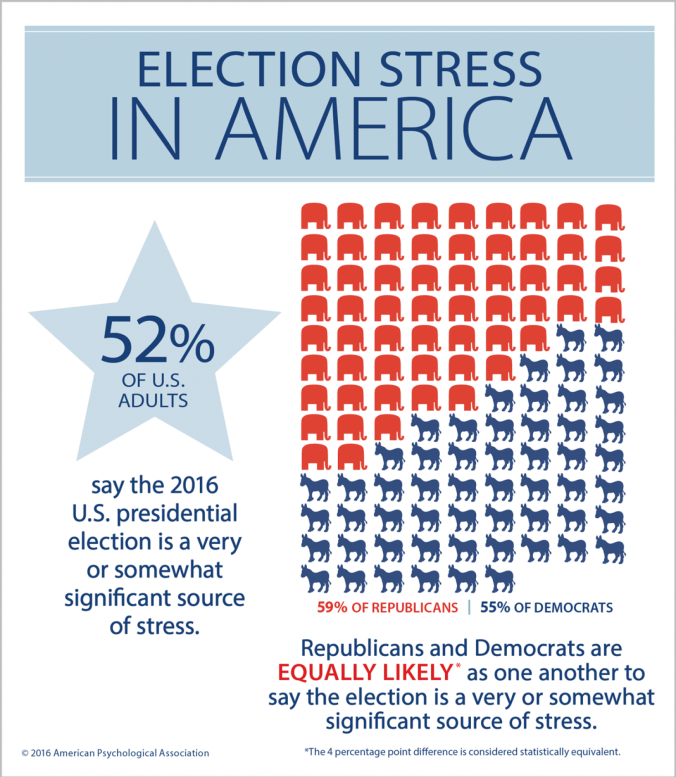
The good news is that we’re in the final countdown. As of this post, we have FIVE remaining days. The bad news is that this final countdown is accompanied by a fever pitch of worry, stress, final efforts to rally voters, claims of poll-watching, and antagonism against voters of color. This election is, as I’ve heard several folks say, a veritable dumpster fire for so many reasons. So, if you’re feeling this stress especially, please take note. The APA has offered concrete tips on how to cope (the full press release is here), paraphrased and annotated with my comments below:
LIMIT your media consumption. Read enough to be informed and then close out social media apps. Pick an activity that you truly enjoy, that’s accessible, and that will provide some decompression. Force yourself to do this at least once a day.
Don’t be reluctant to avoid discussing politics if you think the conversation may lead to conflict. It’s OKAY to protect yourself. Try to be aware of how often you’re discussing the election, even with like-minded others.
Stress and anxiety about the outcome is not productive. If you have the time and means, direct your energy elsewhere. Be proactive! Consider volunteering in your community (election or non-election related), especially if you live in a state with critical local and state-level election (hint: if you live in NC, then ding ding ding). Or if you need something less intense, maybe take up baking. This pumpkin bread recipe is a favorite of mine. Yoga is also an incredibly beneficial activity that reduces cortisol and stress.[1], [2]
Whatever happens on Nov. 8, life will go on. Checks and balances exist for a reason. We can expect a significant degree of stability immediately after a major transition of government. Avoid catastrophizing, and maintain a balanced perspective. This suggestion, especially, is what many apocalypse-fearing people might need to restore their faith. I’m putting my faith in this point, because I need to, despite my catastrophizing self warning me to disregard it. I urge you to do the same.
Vote. Vote. Vote. Vote. It’s the least you can do. And then, of course, take a selfie with your “I voted” sticker and post it with pride. Don’t forget to close out of social media immediately afterwards.
A lot of folks are scared. Some are just fed up and 9 months past cynical. Taking care of yourself is critical in these next few days. Be mindful of what you’re thinking, feeling, eating, doing. Pay attention to your environment and know your triggers.
On Nov. 9, the next chapter begins. Until then, take care of yourself. We can go from there.

Mindful breathing exercise: inhale as the shape expands. Exhale as it contracts. (Source: mathani.tumblr.com)
[1] Chong, Tsunaka, Tsang, Chan, & Cheung. (Jan/Feb 2011). Effects of yoga on stress management in healthy adults: A systematic review. Alternative Therapies in Health and Medicine, 17, 32-38.
[2] West, Otte, Geher, Johnson, & Mohr. (2004). Effects of Hatha yoga and African dance on perceived stress, affect, and salivary cortisol. Annals of Behavioral Medicine, 28, 114-118.


 In other words, people likely have the capacity to change the intensity of their love for someone. And there’s an upside to that, of course. As a relationship evolves, it takes on a new depth leading to greater feelings of intimacy and more intense love. But sometimes—often—it doesn’t. People break up. They fall out of love. Sometimes, you love what you can’t have. What then? Who hasn’t been in a situation where they were on the receiving end of inadequate love or where they couldn’t reciprocate the love someone else had for them? Regardless of the position, it’s often devastating.


 Which is why well-intentioned Clinton supporters or progressives who use cognitive-based attitudes fail to persuade Trump supporters. It’s why progressives who resort to fear, as in “Trump will start a nuclear war!” (could he? It’s possible), come up against a brick wall with Trump supporters. For many of them, their support of Trump is not cognitively-based, so that appeal won’t work. It’s why telling them Donald Trump is
  Of course, the presidency is much higher stakes than a typical attitude change situation.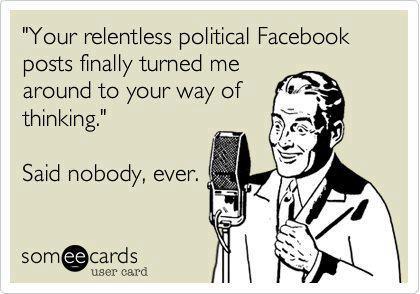
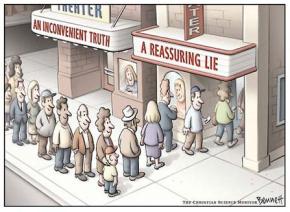
 The articles we post are a proxy of who we are, a strategic presentation of self, a way to shape others’ thoughts and assumptions about us.1 How many times have you or someone you know unfriended someone because of something they shared or said on Facebook? These intended perceptions are not necessarily false or distorted. In the examples above, the person posting may legitimately be a liberal compassionate good person. Wanting others to see that and taking care so that they do is not false. Furthermore, strategic self-presentation on Facebook or any social media, for that matter, is not constrained to the political domain, although the election makes this post oh so timely.
 Social PsyQ