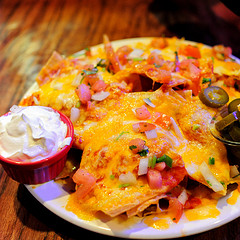
Standard cheesy nacho connectedness (Image courtesy of flickr user Eddie Welker)
Have you ever picked up a chip from a plate of nachos only to find that it was stuck to several others, creating one large nacho mass of cheesy goodness? Or maybe it happened with cookies that had been baked together. Regardless of the specific food, how many times have you looked at that larger-than-intended portion in your hand and shrugged while thinking, it’s still just one nacho (or cookie or whatever). If so, you are not alone!
People are constantly inundated with a multitude of stimuli from their environments, particularly when making decisions about eating. To simplify things a bit, people rely on heuristics (or mental shortcuts) to keep them from becoming overwhelmed by the number of decisions, such as how many cookies to eat, what type of cookies, when do I want them, and so on.
The unit bias heuristic is the tendency to sense that a single entity is the appropriate amount of food to eat, regardless of how big that entity is (1). In other words, eating a cookie, no matter how big that cookie is, feels acceptable and not guilt-inducing to most people, despite the fact that the cookie size may actually be comparable to three cookies.
Naturally, people vary in how frequently they rely on unit bias and also in the size of the typical unit used. For example, one large cookie or a full package of cookies can both be considered to be a single unit depending on the person or the circumstance. Unit bias doesn’t become particularly problematic to people’s health unless they are regularly consuming extra-large portions as one unit, such as a full bag of chips or an entire box of cereal.* In these cases, people may need external support, sometimes called segmentation cues (2), to provide indicators to stop eating. Segmentation cues are also often called “portion control.” For example, 100-calorie snack packs act as a cue to limit your intake of a particular food item.
To learn more about unit bias and segmentation cues, check out the papers below, or email us at Socialpsyq@gmail.com.
(1) Geier, A.B., Rozin, P., & Doros, G. (2006). Unit bias: A new heuristic that helps explain the effect of portion size on food intake. Psychological Science, 17, 521-525.
(2) Geier, A.B., Wansink, B., & Rozin, P. (2012). Red potato chips: Segmentation cues can substantially decrease food intake. Health Psychology. Advance online publication. doi: 10.1037/a0027221
* Of course, these portions don’t apply to everyone. If someone is a high performance athlete, for example, then their calorie intake will look very different from the average person.

 Social PsyQ