10 Days of Christmas…Consumerism: Day 4

SEM

Structural equation model from Dholakia, Bagozzi, & Pearo, 2003

In the digital age, when so much holiday shopping occurs online, how are consumers socially influenced? The answer is: surprisingly a lot. The average adult in the US spends 5 of their waking hours online. But what are we doing online? We’re on social media, we’re reading and commenting on news articles and discussing that internet content with others. Consider the last time you were with a friend and you brought up an article you saw online, or a post from Instagram. This is part of the way that content goes viral, this word of mouth advertising from trusted others. Word of mouth moves even faster on the internet, with websites like Yelp and Amazon at our fingertips, reviewing products and services from plumbers to stereos.

Social influence is the highest in virtual contexts when people are engaged in relationships, in real life or within a brand community. This is because we’re most influenced by our ingroup members (people we consider part of our social circle, or group within society, e.g. all people of one race, all people of one social class or all alumni of the same college).1 When we’re engaged in virtual brand communities, we form social bonds with that group, creating an ingroup of people and increasing identification with the brand.2 Brand communities can also invoke peer pressure, like pressure to conform in some undesired group discussion, and establish community norms, created and maintained by the moderators and high profile members of the those communities.2 Check out the graphic for a depiction of the incredibly complex process of creating web content through social influence.

Brands themselves have social influence, especially if they are “identity signaling brands.” An identity signaling brand is something that announces you to the world and says, “This reflects who I am as a person.” Not surprisingly, while people tend to stick with the status quo and purchase the same things as others, in identity signaling domains that include displays of wealth or social class, they want to be seen as unique.3 But we all also vary on our need for uniqueness, with some individuals needing to stand out from others, and some preferring to fit in through their choices as consumers.4 For instance, when shopping for a car, someone with a high need for uniqueness may buy a Smart Car (rare here in America), while someone with a low need for uniqueness may buy a Honda (quite common in America). Someone who sees his or her car as an identity signal may be more likely to want to purchase an expensive and rare car, like a Bugatti, to show others that they are different.

It is the job of marketers to be persuasive, and to increase demand for products within the community. And, meanwhile, it is human nature to be influenced by the words and actions of others, as well as our own desires to fit in or stand out. Beware before you engage in social activities based around brands this holiday season! Harnessing the power of peers and the power of consumer goods is a potent combination.

  1. Cialdini, R. B., & Goldstein, N. J. (2004). Social influence: Compliance and conformity. Annual Review of Psychology, 55, 591-621.
  2. Algesheimer, R., Dholakia, U. M., & Herrmann, A. (2005). The social influence of brand community: evidence from European car clubs. Journal of Marketing, 69(3), 19-34.
  3. Berger, J., & Heath, C. (2007). Where consumers diverge from others: Identity signaling and product domains. Journal of Consumer Research, 34(2), 121-134.
  4. Tian, K. T., Bearden, W. O., & Hunter, G. L. (2001). Consumers’ need for uniqueness: Scale development and validation. Journal of Consumer Research, 28(1), 50-66.

10 Days of Christmas…Consumerism: Day 3

Screen Shot 2014-12-18 at 11.22.08 AM

Image from Phys.org

Yesterday, we discussed how contagion may play out in the marketplace, and how other people may affect our brand evaluations. But social influence is ever-present in our lives as consumers, affecting our impressions and our behavior in many ways. Consider how you hear about new bands, or hot clothing trends. Often, we become exposed to these things through our environment. Specifically, through the influence of what marketers call early adopters.

Early adopters are people who are “ahead of the curve” on new trends, and they’re the people you know who always have the new technology, who always have the new clothes and generally know about trends before others. Once those early adopters begin influencing their community, the trend increases exponentially in popularity, through word of mouth and the visibility of the trend. The diffusion of the trend is even faster in close, heterogeneous groups like schools or small towns.1 But, make no mistake, early adopters are just as influenced by us as we are by them. Researchers have found that early adopters enjoy consumption visibility, or, the fact that other people recognize them as early adopters because of their purchasing choices.2 They have a cooler phone than you, and they want you to know it.

Social influence can also alter our brand choices, even when the influence is coming from a total stranger. A study by Maryland and Duke researchers uncovered evidence that incidental consumer brand encounters significantly influence product choices.3 Participants were shown 20 photographs of people engaged in mundane activities, like waiting for the bus.3 Within those photographs, participants either saw 0, 4 or 12 pictures that included a bottle of Dasani water near the person.3 They then asked participants to choose 1 of 4 brands of bottled water, with Dasani among the brands.3 Controlling for participants who explicitly noticed the Dasani water in the pictures, participants who viewed 12 pictures with Dasani brand images were more than 25% more likely to choose Dasani bottled water than those who saw none or only 4.3 While this may seem obvious, this is the reason advertisers flood you with repeated brand messages in hopes of altering your purchasing intentions. Fight the repetitive power!

So, you heard it here first folks, go out and be the anonymous consumer influences you were born to be!

  1. Delre, S. A., Jager, W., & Janssen, M. A. (2007). Diffusion dynamics in small-world networks with heterogeneous consumers. Computational and Mathematical Organization Theory, 13(2), 185-202.
  2. Fisher, R. J., & Price, L. L. (1992). An investigation into the social context of early adoption behavior. Journal of Consumer Research, 477-486.
  3. Ferraro, R., Bettman, J. R., & Chartrand, T. L. (2009). The power of strangers: The effect of incidental consumer brand encounters on brand choice. Journal of Consumer Research, 35(5), 729-741.

10 Days of Christmas…Consumerism: Day 2

Screen Shot 2014-12-16 at 6.17.21 PM

Image from New York Times

Yesterday, we discussed how product contagion works. But other people can also change our impressions about products. These people can be celebrities used to promote a product by associating themselves with it, or they can be other consumers in the marketplace or salespeople you encounter. As always, our impressions as consumers are shaped by those around us.

In a particularly interesting line of research, experimenters found that people are far less likely to purchase products that other people have touched.1 In their study, participants were asked to find a salesperson in the university bookstore and purchase a particular shirt.1 The salesperson was a confederate (another experimenter posing as a civilian) who told participants one of 3 things: Another customer was currently trying on the only shirt, that the shirt was on the return rack outside of the dressing room or that the shirt was on a display in the store like all of the other merchandise.1 Results indicated that people who knew another person had just tried on the shirt were the least likely to buy the shirt, had the least positive evaluations of the shirt and had significantly higher feelings of disgust for the shirt.1 People who saw the shirt on the rack had more positive evaluations and were more likely to purchase the shirt.1 As with product contagion, the other person “rubbed off” on the product itself, altering participants’ evaluations. This same group of researchers found a caveat to this finding: people have slightly higher product evaluations if the person who touched the product was attractive.2

Other people can also affect shopping experiences through what one researcher dubbed “accidental interpersonal touching” incidents.3 This researcher found that shoppers who were accidentally touched by another customer while they were looking at a product had significantly more negative brand evaluations than participants who were not touched while evaluating the same product.3 The holiday season is certainly famous for this, so let’s all do the economy a favor and keep our hands and bodies to ourselves.

We can also “catch” positive moods from others, which increases positive product attitudes.4 This may be why people are swayed to buy clothing items when salespeople or other customers tell them how wonderful they look in it. However, the person you’re interacting with has to be liked, or the effect can actually backfire and decrease product evaluations.4

The mall is a veritable field experiment in consumer psychology, so stay on your toes and do the beleaguered sales associates and your fellow consumers a favor and stop touching everything.

  1. Argo, J. J., Dahl, D. W., & Morales, A. C. (2006). Consumer contamination: How consumers react to products touched by others. Journal of Marketing, 70(2), 81-94.
  2. Argo, J. J., Dahl, D. W., & Morales, A. C. (2008). Positive consumer contagion: responses to attractive others in a retail context. Journal of Marketing Research, 45(6), 690-701.
  3. Martin, B. A. (2012). A stranger’s touch: effects of accidental interpersonal touch on consumer evaluations and shopping time. Journal of Consumer Research, 39(1), 174-184.
  4. Howard, D. J., & Gengler, C. (2001). Emotional contagion effects on product attitudes. Journal of Consumer Research, 28(2), 189-201.

10 days of Christmas…Consumerism: Day 1

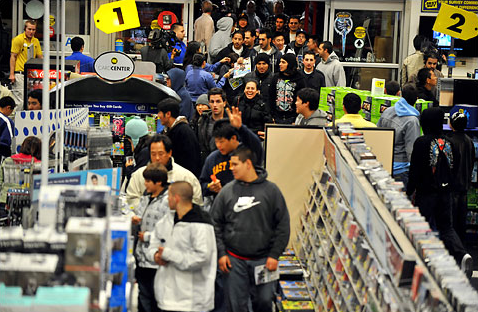
‘Tis the holiday season, and we all know what that means: the mecca of consumerism that is America will ring out with the song of overworked cash registers throughout the land. Anyone who has been anywhere near a mall in America in the month of December knows how incredibly unpleasant it is to be swarming all over shopping mall wares while other people are all up in your business. In honor of this time of cheer, materialism and accidental stranger touching, we present the 10 days of Christmas…Consumerism (What? You wanted 12? I had finals!).*


Product contagion is a well-studied topic in consumer behavior. Essentially, much like the way humans can catch a disease, products can “catch” qualities via associations with other products or people. The proximity of the products operates as the basic idea behind product contagion, i.e. a product that is located close to another product may take on some characteristics of that other product, and affect consumer perceptions. For instance, products that have an equal chance of gain, like a free sample, tend to be seen as higher value when they are clustered together, while products with an equal chance of loss, like defected products, are seen as less desirable when located close to other defective products.1

There has also been work on product contagion when the proximity is to a disgusting product. Researchers have found evidence that a product location next to a disgusting product can cause the non-disgusting product to “catch” disgusting qualities, especially when packaging is clear and regardless of whether or not the two products are physically touching.2 This association has proven to be long-lasting, with impressions of disgust permanently attaching themselves to the non-disgusting product.2 So, basically, the next time you really want the last of something at the grocery store but you can’t buy it right now, put it next to the adult diapers and you’re probably home free.

Keep shopping and come and see us tomorrow for consumer contamination. Talk about a bad touch.

*The Christmas reference in this title is being made by a born and bred atheist and purely for Google/seasonal reasons. No offense meant to anyone, and certainly no religious preferences here at SocialPsyQ!


  1. Mishra, A. (2009). Influence of contagious versus noncontagious product groupings on consumer preferences. Journal of Consumer Research, 36(1), 73-82.
  1. Morales, A. C., & Fitzsimons, G. J. (2007). Product contagion: Changing consumer evaluations through physical contact with “disgusting” products. Journal of Marketing Research, 44(2), 272-283.

Will mandatory calorie labeling change food behavior?

Heads up! The Food & Drug Administration (FDA) recently finalized two rulings, effective December 1, 2015, regarding calorie and nutrition labeling for food items sold in vending machines and restaurants.

Food Labeling; Calorie Labeling of Articles of Food in Vending Machines*:

 “The declaration of accurate and clear calorie information for food sold from vending machines will make calorie information available to consumers in a direct and accessible manner to enable consumers to make informed and healthful dietary choices.”

 Food Labeling; Nutrition Labeling of Standard Menu Items in Restaurants and Similar Retail

Food Establishments*:

Providing accurate, clear, and consistent nutrition information, including the calorie content of foods, in restaurants and similar retail food establishments will make such nutrition information available to consumers in a direct and accessible manner to enable consumers to make informed and healthful dietary choices.”

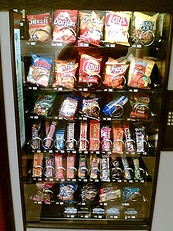
Photo by Flickr user Steve W

Typical American vending machine circa 2006

Although long overdue and incredibly welcome, the statute as written implies that information is not just necessary but a sufficient means of healthier eating. The information enables the consumer to make decisions with the optimism that knowledge will be the impetus to a healthier lifestyle. The FDA is right that knowledge and information are essential to healthier eating, but assuming that consumers will make informed and healthful dietary choices simply because the options are there is wishful thinking. People know the “right” thing to do or eat a lot of the time, but simply knowing doesn’t translate into doing—intention is also an important element, among other factors like perceived control over behavior and past behavior1.

I’m not criticizing the FDA for not doing more nor am I dismissing the effort put forth by health advocates who worked for these rulings for decades. These mandates represent progress, but they are not sufficient. Labeling and providing calorie totals is hardly enough to curb calorie intake. In a 2009 study that looked at fast-food choices of people** in New York after the introduction of a menu-labeling mandate, researchers found no difference in calories purchased compared to a control group in a city where no menu-labeling mandate existed. This finding was despite the fact that nearly 30% of participants indicated that the calorie labels influenced their decisions2. Awareness doesn’t automatically translate into action.

In fact, sometimes knowing the healthiest option on the menu is enough to make someone choose the least healthy option. Though the decision seems counterintuitive, the behavior exists, and it’s called vicarious goal fulfillment3. Basically, what that means is that people see the salad item on the menu and its calorie total, and it reminds them of the salad they had last week or the one that they promise they’ll eat tomorrow. Feeling justified, people can then order the bacon cheeseburger. It sounds completely counter-intuitive, but the evidence exists.

Let’s take a look at some of the other factors at play when making food decisions in addition to calorie information:

Living with the rule of thumb “everything in moderation:” We all know this mantra. Nutritionists and laypeople alike have endorsed it as an effective means of weight management, but the amount that constitutes moderation is ambiguous, which allows people to interpret it as they see fit. Does moderation mean eating a single cookie or just one sleeve of cookies in a package? For most people, moderation depends on the amount they typically eat. People tend to interpret information in a self-serving way, so those who do eat an entire sleeve of cookies may genuinely believe the amount is moderate, particularly if the alternative is to eat the entire package. In fact, research I collaborated on found that people considered moderation to be slightly more than what they typically ate4. In other words, everyone thought that they ate in moderation, but the definition of moderation varied dramatically by person.

These findings suggest that visible calorie or nutrition information won’t necessarily alter the food people choose when ordering or at a vending machine. Instead, people are more likely to order the same food and then shift their definition of moderation to match what they ate.

Eating with others: An abundance of evidence finds that eating with other people influences everything from what we eat to how much5. Generally, people eat more when they eat with other people unless the others are strangers6. When eating companions are unknown or merely acquaintances, people are much more likely to limit how much they eat so as not to seem sloppy or greedy or any of the other labels that are placed on people who eat “a lot.” Think about a first date you had that involved dinner. What did you order? Did you decide not to order something in particular because of what it might signify to your date? Did you eat more carefully than usual? Maybe you ate less than you usually do. Eating with people you do know may impose a separate set of social pressures to keep up with the group, whether that means ordering dessert for everyone to split or getting a salad with the dressing on the side so you aren’t the odd person out.

Even the gender and appearance of people who are around us in our eating environment can influence the food we choose7. For example, people who order food after a thin person who has ordered a lot of food are more likely to increase the amount they eat, too. The reasoning seems to be that if it’s okay for a thin person to eat that much, then I can, too.  Much of this behavior doesn’t occur at the level of conscious awareness; rather, it’s a quick decision we make automatically without necessarily realizing the aspects that factored into it.

I should note that, although these trends apply across all genders in the United States (where the majority of the research reported here has been conducted), social norms differ for men and women regarding how they should eat. Whereas men may feel pressured to eat more meat to be masculine, women may feel that they must eat less or something “light” so they don’t seem too unfeminine8.

Does this salad make me look feminine?

Does this salad make me look feminine?

All of these factors that you may or may not have been aware of influence your eating patterns,  often above and beyond objective information like calorie labels. In other words, your eating  companions are much more likely to influence your decision on their own or in combination  with the calorie information than the calorie info by itself.

For more information on how eating with others is different from eating alone, keep an eye out  for our upcoming mini-series on social eating.

 Licensing: That feeling of deservingness you have when you worked your butt off earlier in  the day or decided not to have dessert after lunch, for example, that makes you feel entitled to a treat. In simplest terms, licensing is self-justified indulging of (often unhealthy) foods for a variety of reasons, including feeling that you deserve it, availability of the food, intentions to make up for the indulgence later, curiosity about the food, feeling that it’s an exception to what you usually eat, and irresistibility of the food9. See our Justifying Indulgence on Thanksgiving post for more details. In a licensing situation, calorie information is likely to be less important than if someone had not previously decided to indulge.

Another possibility in a licensing situation with visible nutrition information is that the food item that people plan to indulge in may not contain as many calories as people expected, which may lead them to order additional calories at that time or later that day. Maybe you weren’t planning to order fries with your burger, but now that you know the burger only has 300 calories, all bets are off.

~~

These are just a few of the factors at play when people make decisions about what and how much to eat. Most of these influences will occur regardless of whether calorie or nutrition information is available. Furthermore, the very people who may be put off by the calorie amounts likely weren’t eating much of that food anyway. At the other extreme is the group of people who will eat whatever they want, regardless of the calorie amounts. A middle group of consumers exists, however, that we haven’t yet discussed. That group is composed of people who generally try to watch what they eat but can’t be bothered too much by it. And this middle group might be bigger than the other two. Maybe it’s the category you fall into. That group may make food decisions for other groups that wouldn’t change their patterns, like a mother or father deciding for a child. That middle group might also be people who have the intention to eat better, but McDonald’s is the only restaurant in their town. For this middle group, visible calorie and nutrition information may start to speak louder than the other factors. Visible calorie and nutrition information may eventually make its way into people’s working knowledge of nutrition, and knowledge is an initial necessary step to intentional behavior change.

Read more about the statutes here. If you’re interested in many of the other aspects of food decisions, check out Brian Wansink’s work here.


* Only vendors and companies operating at least 20 vending machines/stores are required to follow this new mandate.

** This study focused on low-income people, who may have the additional goal beyond health of getting the most calories for the least amount of money. Unfortunately, these two goals are often at odds with each other.


1 Ajzen. (1991). The theory of planned behavior. Organizational Behavior and Human Decision Processes.

2 Elbel, Kersh, Brescoll, & Dixon. (2009). Calorie labeling and food choices: A first look at the effects on low-income people in New York City. Health Affairs.

3 Wilcox, Vallen, Block, & Fitzsimons. (2009). Vicarious goal fulfillment: When the mere presence of a healthy option leads to an ironically indulgent decision. Journal of Consumer Research.

4 vanDellen, Isherwood, & Delose. (2014). Everything in moderation? Moderation messages are ineffective for healthy eating. Unpublished manuscript.

5,6 Herman, Roth, & Polivy. (2003). Effects of the presence of others on food intake: A normative interpretation. Psychological Bulletin.

7 McFerran, Dahl, Fitzsimons, & Morales. (2010). I’ll have what she’s having: Effects of social influence and body type on the food choice of others. Journal of Consumer Psychology.

8 Bublitz, Peracchio, & Block. (2010). Why did I eat that? Perspectives on food decision making and dietary restraint. Journal of Consumer Psychology.

9 Taylor, Webb, & Sheeran. (2013). ‘I deserve a treat!’: Justifications for indulgence undermine the translation of intentions into action. British Journal of Social Psychology.

The Skinny on Online Dating: Psychology at work

Image from Mashable.com

          Image from Mashable.com

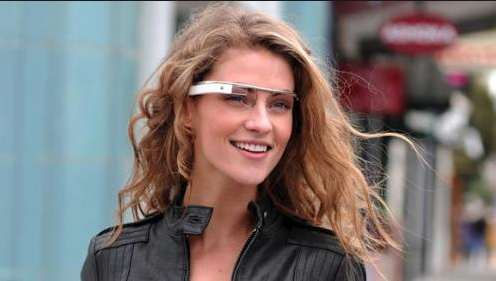
In Meg Jay’s book The Defining Decade: Why your twenties matter—and how to make the most of them now, she makes a point that online dating is a good idea, because it matches people based on personality traits-something that predicts long-term relationship success. In real life, relationships may form because two people happen to be at the same bar, or have a mutual friend. But research has shown time and time again that similarity attracts.1,2 Given the way online dating sites work, by matching people based on compatibility of personality and preferences, it is not surprising that more than a third of marriages now start online. And, according to the Pew Research Center’s 2013 report on online dating, 38% of single American adults looking for a partner have used online dating sites or apps. Of Americans who found their spouse online, they report higher marital satisfaction and lower divorce rates than couples that met IRL.3

With the current popularity of apps like Tinder and sites like OkCupid, it’s impossible to ignore the psychological field experiment that is online dating. There are 3 areas of psychology research that are incredibly relevant to online dating: Personality, self-presentation and deception.

Personality– Many online dating sites require users to fill out a battery of questions, several of which are focused on personality characteristics. A question, “Do you like wild parties?” appears in OkCupid’s personality questionnaire, which psychologists may recognize as a version of the sensation-seeking personality item “I like wild parties.”4 In addition to direct adaptations of established personality questionnaires, questions ask about cleanliness and keeping promises (conscientiousness), new experiences and adventurousness (openness to experience), if you would do things just because your partner wanted to (agreeableness), if you like to talk or meet new people (extraversion) and if you get jealous and worried about things you can’t change (neuroticism). As you can see, and as Meg Jay suggested, these sites evaluate users largely based on what is known as the Big 5 of personality.5,6 Research has found that romantic attachment styles relate to the Big 5, and various personality traits correlate with specific relationship outcomes, like neuroticism and decreased relationship satisfaction.7,8

Self-presentation– With the high stakes of finding a meaningful relationship, online dating users may choose to engage in self-presentation: the practice of managing the impressions we make on others.9 Research suggests that self-presentation motives may be especially salient because creating online content gives people an opportunity to overtly self-promote.10 Evidence suggests that it may be easier to self-present in a positive light than one may think. Being seen as socially expressive, presenting an ideal self, engaging in self-disclosure and “matching your profile” when meeting in person can all contribute to self-presentational success.11,12,13,14 Self-presentation concerns stay consistent throughout the lifespan, with aging men still preferring youth and physical attractiveness, and leveraging information about status on their own online dating profiles.15

Deception– Sometimes self-presentation goes beyond a favorable description of the self, and veers toward untruthfulness. Studies by Toma and Hancock found that people who were rated lower in attractiveness by independent raters were more likely to lie about physical descriptions, and use an “enhanced” profile picture.16 Another study by the same group of researchers found that women were more likely to use deceptive pictures than men, using younger pictures, or pictures taken by a professional, among other tactics; but that only about 1/3 of profile pictures were rated as inaccurate.17 Yet another study found that men were more likely to post deceptive information about financial assets, relationship goals and their own interests and attributes, and women were more likely to post misleading information about their weight.18

While the increasing popularity of online dating indicates it may be the way of the future, the psychological principles behind it are time-tested and peer-approved.

Our area head, Dr. Mark Leary, is one of the foremost experts on self-presentation. You can find his self-presentation-related Google Scholar results here.

  1. Byrne, D. (1961). Interpersonal attraction and attitude similarity. The Journal of Abnormal and Social Psychology, 62(3), 713-715.
  1. Byrne, D. & Griffitt, W. (1969). Similarity and awareness of similarity of personality characteristics as determinants of attraction. Journal of Experimental Research in Personality, 3(3), 179-186.
  1. Cacioppo, J. T., Cacioppo, S., Gonzaga, G. C., Ogburn, E. L., & VanderWeele, T. J. (2013). Marital satisfaction and break-ups differ across on-line and off-line meeting venues. Proceedings of the National Academy of Sciences of the U.S.A, 110(25), 10135-10140.
  1. Hoyle, R. H., Stephenson, M. T., Palmgreen, P., Pugles Lorch, E., Donohew, R. L. (2002). Reliability and validity of a brief measure of sensation seeking. Personality and Individual Differences, 32, 401-414.
  1. Goldberg, L. R. (1990). An alternative “Description of Personality”: The big-five factor structure. Journal of Personality and Social Psychology, 59(6), 1216-1229.
  1. Gosling, S. D., Rentfrow, P. J., & Swann Jr, W. B. (2003). A very brief measure of the Big-Five personality domains. Journal of Research in Personality, 37, 504-528.
  1. Shaver, P. R. & Brennan, K. A. (1992). Attachment styles and the “Big Five” personality traits: Their connections with each other and with romantic relationships outcomes. Personality and Social Psychology Bulletin, 18(5), 536-545.
  1. White, J. K., Hendrick, S. S., & Hendrick, C. (2004). Big five personality variables and relationships constructs. Personality and Individual Differences, 37(7), 1519-1530.
  1. Leary, M. R. & Kowalski, R. M. (1990). Impression management: A literature review and a two-component model. Psychological Bulletin, 107(1), 34-47.
  1. Schau, H. J. & Gilly, M. C. (2003). We are what we post? Self-presentation in personal web space. Journal of Consumer Research, 30(3), 385-404.
  1. Weisbuch, M., Ivcevic, Z., & Ambady, N. (2009). On being liked on the web and in the “real world”: Consistency in first impressions across personal webpages and spontaneous behavior. Journal of Experimental Social Psychology, 45(3), 573-576.
  1. Ellison, N. B., Heino, R. D., & Gibbs, J. L. (2006). Managing impressions online: Self-presentation processes in the online dating environment. Journal of Computer-Mediated Communication, 11(2), 415-441.
  1. Gibbs, J. L., Ellison, N. B., & Heino, R. D. (2006). Self-presentation in online personals: The role of anticipated future interaction, self-disclosure, and perceived success in internet dating. Communication Research, 33(2), 152-177.
  1. Whitty, M. T. (2008). Revealing the ‘real’ me, searching for the ‘actual’ you: Presentations of self on an internet dating site. Computers in Human Behavior, 24(4), 1707-1723.
  1. Alterovitz, S. S. R. & Mendelsohn, G. A. (2009). Partner preferences across the life span: Online dating by older adults. Psychology and Aging, 24(2), 513-517.
  1. Toma, C. L. & Hancock, J. T. (2010). Looks and lies: The role of physical attractiveness in online dating self-presentation and deception. Communication Research, 37(3), 335-351.
  1. Hancock, J. T. & Toma, C. L. (2009). Putting your best face forward: The accuracy of online dating photographs. Journal of Communication, 59, 367-386.
  1. Hall, J. A., Park, N., Song, H., & Cody, M. J. (2010). Strategic misrepresentation in online dating: The effects of gender, self-monitoring, and personality traits. Journal of Social and Personal Relationships, 27(1), 117-135.

Obesity and public health campaigns: Finding the Holy Grail

Obesity is a disease. It has been since June 2013, at least according to the American Medical Association (AMA). The AMA formally recognized obesity as a disease with the intention that such a classification would prompt additional funding for obesity research. However, a set of studies published in Psychological Science1 earlier this year suggests that designating obesity as a disease without considering the psychological consequences has a variety of positive and negative implications for obese and average-weight individuals.

Across a set of three studies where more than 50% of the 700+ participants were classified as overweight or obese according to the Body Mass Index (BMI), psychology researchers Crystal Hoyt, Jeni Burnette, and Lisa Auster-Gussman found that obese individuals reported significant decreases in weight concern and body dissatisfaction when they received the message that obesity was a disease, whereas average weight individuals demonstrated no such pattern when exposed to the same message. At first glance, this finding suggests that the “obesity as a disease” model is effective at increasing body satisfaction and, perhaps, decreasing internalized stigma.

Choose Health LA County ad campaign

Example of weight management-focused (incremental mindset) public health strategy

At a recent talk I attended, Dr. Burnette discussed these findings as well as related findings from some more recent studies about the relationship between the obesity as disease message and an entity mindset. An entity mindset is the belief that an ability or characteristic, such as intelligence or weight, is fixed and not malleable as a result of effort or behavior change2,3. Burnette suggested that believing obesity is a disease implies that weight is static, that it’s not people’s lack of willpower or behavior making them obese, but rather, their genes and physiologies. This notion seems to decrease anti-fat prejudice and blame placed on obese individuals4. This approach seems promising: reducing stigma and blame, as well as increasing the likelihood of research funding.

There’s a catch, of course. In addition to the decreased weight concern and body dissatisfaction, obese individuals who saw the disease message were also more likely to make hypothetical unhealthy food choices, unlike average weight individuals or obese individuals exposed to the weight-management control. The researchers suggest that these food choices may be a downstream consequence of the disease label and the entity mindset it may induce. That is, if obesity indicates a physiological malfunction, thus making weight control efforts ineffective, why bother trying? The very message that decreases blame seems to reduce motivation to manage weight, too.

The belief that weight loss efforts are ineffective for obese individuals is not completely implausible. Food researcher Traci Mann and fellow obesity researchers have found that long-term weight loss for obese folks is the exception, not the norm. Receiving the message that obesity is a disease and fixed may be affirming to an obese person who was previously told that weight loss attempts were a personal failing. Regardless, it could be argued that the positive impact of affirmation and acceptance is diminished if it’s accompanied by regular unhealthy food choices.

In contrast, obese participants who were shown the control message of standard weight management strategies demonstrated a different pattern. Their concern for their weight did not decrease, but nor did they subsequently choose higher-calorie, unhealthy foods. The implication, which the researchers mention, is that some level of mild body dissatisfaction may be motivating to eat healthier foods and to be more active. But these findings present something of a double-edged sword, as Dr. Burnette mentioned at her recent talk.

The weight management (control) message may have induced an incremental mindset of weight, the alternative to an entity mindset about weight. An incremental mindset affords people more agency by implying that weight can be altered, presumably through behavior change. Accompanying empowerment, however, is the shift in blame away from an obese person’s genes and onto them and their behavior. As Burnette said, promoting either mindset to obese and non-obese individuals alike can have negative effects.

So, what’s a public health professional to do, particularly when obesity has already been officially labeled a disease? It’s exactly that sort of question that Burnette and her collaborators would like to pursue in future research. Specifically, how should public health messages be structured to motivate and promote an incremental mindset for obese individuals without the body image costs and blame? No obvious or simple answers exist yet. Burnette says that the answer to that question would be “the Holy Grail.”

Anyone out there come across research that might answer this or have a suggestion? Post it in the comments!


1Hoyt, C.L., Burnette, J.L., & Auster-Gussman, L. (2014). “Obesity is a disease”: Examining the self-regulatory impact of this public-health message. Psychological Science, 25, 997-1002.

2 Dweck, C.S., Chiu, C.Y., & Hong, Y.Y. (1995). Implicit theories and their role in judgments and reactions: A world from two perspectives. Psychological Inquiry, 6, 267-285.

3 Burnette, J.L., O’Boyle, E., VanEpps, E.M., Pollack, J.M., & Finkel, E.J. (2013). Mindsets matter: A meta-analytic review of implicit theories and self-regulation. Psychological Bulletin, 139, 655-701.

4Monterosso, J., Royzman, E.B., & Schwartz, B. (2005). Explaining away responsibility: Effects of scientific explanation on perceived culpability. Ethics & Behavior, 15, 139-158.


The Salem Witch Trials: Groupthink at its worst

In honor of Halloween and all things occult, I wanted to explore a historical event I was morbidly fascinated with as a child: the Salem Witch Trials. When I was younger, I couldn’t get my hands on enough novels and non-fiction books on the subject. I read The Crucible and watched the movie, and I was also fortunate enough to have relatives who lived in Salem, MA, so I got to visit most years around Halloween. While in Salem, I would walk through the cemeteries where the alleged witches had been laid to rest and read their tombstones. These ancient tombstones actually listed the method used to kill the accused. I remember being completely engrossed in the event the more I learned about it—I couldn’t get past the swiftness of the accusations, the unfairness of the trials, the conformity, and the upturned power hierarchy of the Salem community. I didn’t necessarily think of it in those specific terms at the time, but in retrospect, my nascent social psychological wheels were turning.

What exactly happened during the Salem Witch Trials? What perpetuated the mass hysteria? Why did it take so long to stop?

Lithograph of Salem Witch Trials, 1892, by Joseph Baker

Actually, research on groupthink suggests that what happened in Salem Village* wasn’t all that unusual; terrible, yes, but surprising? Perhaps not. A few factors combined to allow for the perfect storm of the Salem Trials.

Groupthink1 is a way of thinking characterized by an excessive emphasis on group cohesion and solidarity. Often, group harmony is prioritized over making an accurate judgment, allowing for important information to be ignored. Groupthink is most likely to occur when the group is highly cohesive, isolated, stressed, has poor decision-making procedures, and a forceful leader. Nearly all of these factors existed in Salem Village during the winter of 1692, the time leading up to and including the witch trials.

Highly cohesive group and group isolation. The Salem villagers were Puritans, tightly knit together by their religious beliefs, including fear of the Devil’s work. Because of their religious convictions, recent attacks by Native Americans, and tension with the wealthier Salem Town, the Salem villagers were distrustful of outsiders, leaving them to rely primarily on each other for support.

Forceful leader. Reverend Samuel Parris, the first ordained minister of Salem Village, ruled strictly and was known for his greedy nature. Editorial note: he doesn’t seem like the type of person who would allow people to speak their mind.

High stress. The 1692 winter was a particularly harsh one, which strained Salem Village’s resources and increased their reliance on Salem Town. Adding to the strain was a number of displaced people from King William’s War, who landed in Salem Village, and a smallpox epidemic.

Poor decision-making. The trial process, a term I use loosely, allowed testimony about dreams and visions to be included, despite opposition from the respected minister Cotton Mather; likely, his voice just wasn’t loud enough to stop the momentum yet. Female children as young as four years old who were connected to accused older women, like Dorothy Good, daughter of Sarah Good, were questioned and thought to have confessed. These are just a few of the ways in which poor decision-making was employed.

So, the groundwork was there. And when groupthink emerged, it did so violently with all of its accompanying symptoms:

Belief in the moral correctness of the group. Need I remind you that these were deeply religious people? They prayed every day and considered themselves to be the elect. In other words, they believed they had been predestined for heaven, chosen uniquely by the God they believed in. As K. David Goss put it in Daily Life during the Salem Witch Trials, their Puritan faith was all-encompassing. These religious beliefs contributed to a lot of self-censorship and the pressure to conform, particularly among women, who were expected to aspire to the ideal virtuous woman as described in the bible (see Goss’s book for more). This pressure to conform and to limit personal beliefs likely increased significantly once accusations were being made, lest someone turn an accusation on someone who dared to speak her mind.

Considering the ripening groupthink conditions of the stressed and isolated place of Salem Village, the mass hysteria and frenzy of the Salem Witch Trials wasn’t completely unexpected, at least in hindsight. That it can be explained doesn’t detract from the horror, death, and upheaval that occurred. And community members of Salem did eventually put a stop to the madness, perhaps because the stress was unsustainable and damaged the group cohesiveness. The diminished cohesiveness may have allowed an opening for some powerful community members to feel comfortable enough to speak up. A public apology was eventually made in 1697 by Judge Sewall, who had overseen many of the trials, but it was too little, too late. Groupthink had left a permanent mark.

Groupthink can, and does, occur today, too. It can be avoided by having an impartial leader, being willing to seek outside opinions, creating subgroups to make decisions separately, and seeking anonymous opinions.2


*The place where the witch trials occurred was actually Salem Village, present-day Danvers, and was established several miles from Salem Town, now present-day Salem. See http://salem.lib.virginia.edu/Witch.html for more information.

1,2  Janis, I.L. (1972). Victims of groupthink: A psychological study of foreign policy decisions and fiascoes. Boston, MA: Houghton Mifflin.

Get Psyched for Halloween!

Image from Nutritious Eats

           Image from Nutritious Eats

If you’re like me, some of your favorite childhood memories are of Halloween. You get to dress up like someone or something else, go to strangers’ houses and ask them for treats, cause a little mischief and binge on candy. But the best thing about Halloween? There’s a lot of social psychology at work.

Anonymity: Anonymity may make people more susceptible to group influence.1 This could even help to account for an increase in criminal activity on Halloween. Visual anonymity, specifically, seems to increase identification with the group, be that delinquent peers or society in general.2 Some classic studies have found a direct correlation between stealing and Halloween costumes.3,4 Researchers found that trick-or-treaters who were both anonymous and with a group of other children were more likely to steal candy and money when given the chance.3 Another study found that Halloween masks could elicit a state of deindividuation*, and found evidence that children in masks were more likely to take more candy than unmasked children, when the experimenter was not in the room.4

Norms: Usually, if you knocked on someone’s door at night dressed as a blood-sucking Zombie demanding candy, people would freak out and call the police. But on Halloween, this would be expected, and norms would be altered for the night. You might even be called a party pooper if you don’t make an effort to dress in costume. These kinds of social norms have long been of interest to social psychologists. Descriptive norms are social rules transmitted by others; so when you show up to the Halloween party as the only one in costume, all of a sudden, you feel out of place, even though you would fit in at a more festive party.5 Injunctive norms speak to what should be done, or what is socially endorsed, i.e. you should go to the party in costume because you are supposed to wear a costume on Halloween.5 Social norms are often positive, but they can also lead to higher levels of conformity, riskier decisions and worse decisions through consensus.6,7,8,9 Norms are also at work when people throw costume parties, visit the pumpkin patch or go to haunted houses. Not only does the seasonal social acceptance of the activity encourage us to partake in some strange stuff, our desire to act in accordance with norms is a billion dollar industry ($11.3 to be exact).

Prosocial behavior: The act of handing out free candy to kids is both a Halloween norm, and an example of prosocial behavior. Prosocial behavior is any behavior that works for the good of the group, rather than the good of the self. Things like sharing, taking turns and common courtesy are all types of prosocial behavior. Prosocial behavior has a lot of individual and societal benefits like lower perceptions of competition, higher need for achievement, higher social cognitive abilities in children and may even be linked to higher levels of altruism.10,11,12

It’s clear that our Halloween traditions involve social psychology, from the norms in place that dictate our Halloween activities, the anonymity that allows for increased mischief, and the prosocial nature of some of our Halloween traditions. So this Friday, put your SocialPsyQ to work! What are some social psychology phenomena you see on Halloween?

* Deindividuation is the loss of self-awareness in groups.

  1. Postmes, T., Spears, R., Sakhel, K., & de Groot, D. (2001). Social influence in computer-mediated communication: The effects of anonymity on group behavior. Personality and Social Psychology Bulletin, 27(10), 1243-1254.
  2. Lea, M., Spears, R., & de Groot, D. (2001). Knowing me, knowing you: Anonymity effects on social identity processes within groups. Personality and Social Psychology Bulletin, 27(5), 526-537.
  3. Diener, E., Fraser, S. C., Beaman, A. L., & Kelem, R. T. (1976). Effects of deindividuation variables on stealing among Halloween trick-or-treaters. Journal of Personality and Social Pschology, 33(2), 178-183.
  4. Miller, F. G., & Rowold, K. L. (1979). Halloween masks and deindividuation. Psychological reports, 44(2), 422
  5. Cialdini, R. B., & Trost, M. R. (1998). Social influence: Social norms, conformity and compliance. In D. T. Gilbert, S. T. Fiske, & L. Gardner (Eds). The handbook of social psychology, Vols. 1 and 2 (4th ed.), (pp. 151-192). New York, NY, US: McGraw-Hill.
  6. Sherif, M. (1937). An experimental approach to the study of attitudes. Sociometry, 1(1/2), 90-98.
  7. Asch, S. E. (1956). Studies of independence and conformity: I. A minority of one against a unanimous majority. Psychological Monographs: General and Applied, 70(9), 1-70.
  8. Stoner, J. A. F. (1968). Risky and cautious shifts in group decisions: The influence of widely held values. Journal of Experimental Social Psychology, 4(4), 442-459.
  9. Postmes, T., Spears, R., & Cihangir, S. (2001). Quality of decision making and group norms. Journal of Personality and Social Psychology, 80(6), 918-930.
  10. Puffer, S. M. (1987). Prosocial behavior, noncompliant behavior, and work performance among commission salespeople. Journal of Applied Psychology, 72(4), 615-621.
  11. Denham, S. A. (1986). Social cognition, prosocial behavior, and emotion in preschoolers: Contextual validation. Child Development, 57(1), 194-201.
  12. Eisenberg, N., & Miller, P. A. (1987). The relation of empathy to prosocial and related behaviors. Psychological Bulletin, 101(1), 91-119.

Beating the Wedding Industrial Complex—You can, too!

September and October are becoming increasingly popular months for weddings, overtaking the more traditional wedding month of June, which makes now the perfect time to talk about the wedding industrial complex, or WIC for short. I first heard this term on APracticalWedding.com, where the editor-in-chief Meg Keene wrote a fantastic post on it, and it resonated with me immediately. You see, I’m getting married this weekend. I was in the thick of fighting off the WIC—now I’m almost through!—and it is difficult, despite my knowledge of social psychology.

For those of you who are married, and especially those who got married during the current social media era where social comparison is ever easier, you may already know what I’m talking about. For those of you who would like to get married eventually, consider yourself warned. The WIC is basically all those factors that interact to make the two people getting married feel pressured to have the “right” type of wedding. Note: “right” often translates to traditional and expensive.

The WIC preys on the unsuspecting good-intentioned folks who just want to have a nice wedding. They want to have fun, they want it to be organized and pretty, and they definitely do not want anyone to be hungry. Deciding the specifics that correspond with each of those desires is more ambiguous. Enter the wedding industry. The wedding industry is a $51 billion dollar a year industry that seeks to convince you that you absolutely need to have a fully stocked open bar, and your dress must be Vera Wang with an intricate bouquet to match. Anything less, and your wedding will be just that: less than.

Admittedly, I’m painting a harsh picture of the wedding industry, making them seem calculating and manipulative, all in the goal to get you to spend as much money as possible to have The Perfect Wedding. If I’m being fair, the wedding industry is not the only cause to blame here; after all, the ultimate goal of businesses is to turn a profit. It’s also you. Yes, you, your expectations, societal influence, and more than a little bit of social psychology.

  One of the most egregious examples of injunctive wedding norms I’ve ever seen

Why do we feel the need to stress out over seemingly inconsequential details about the wedding (like whether the cumberbund color will clash with the table runners)* when, realistically, we know that a wedding is not about the color scheme? What it really boils down to is social norms. That is, how people “should” behave and how people are actually behaving. The former is an injunctive norm, and it implies there’s a right and wrong way to do things. The latter is a descriptive norm, and it describes how people are actually behaving.

The injunctive norm tells us that weddings are supposed to have a sit down dinner, that paper flowers are not okay, that not having a bridal party—gasp!—is totally crossing the line. I won’t even get into the proscribed norms about how a bride should look. The descriptive norm incorporates all those wedding experiences of your friends, family, celebrities, and the wedding industry as if to say, “See? This is how weddings are happening all across your world.” Descriptive doesn’t imply that an action or event is right or wrong, but the boundary between descriptive and injunctive seems to get blurry when wedding planning is involved.

Clearly, both types of norms contribute to the wedding industrial complex, because they draw in a person’s experiences and exposure to what the mainstream culture suggests is appropriate for a wedding.

So how can you escape the seemingly impenetrable wedding industrial complex? Well, you can use norms to your own advantage. Specifically, use descriptive norms in a way that promotes and helps your wedding experience. Make your wedding the norm. After all, your wedding should count as much as any of the others. Seek out additional sources of support (like apracticalwedding.com) that diminish any injunctive norms, because there really isn’t a right or wrong way to do weddings. Finally, even if you aren’t planning a wedding yourself right now, be supportive of anyone who is. Don’t contribute to the wedding industrial complex by imposing injunctive norms on anyone. You may have been part of the problem, but you can also be part of the solution!

Wish me luck this weekend.


*Some profanity in here. Potentially NSFW.

**The traditional wedding I’m drawing my norms from refers primarily to a middle-upper class wedding. Admittedly, weddings of all shapes and sizes exists with their own accompanying pressures!